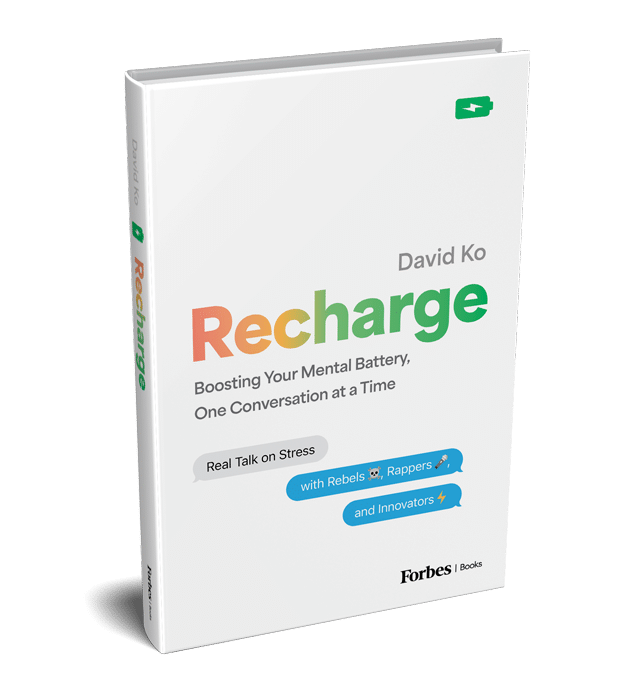

I used to equate powering through a challenge with resilience. I could not have been more wrong.
The American Psychological Association (APA) defines resilience as: “The process and outcome of successfully adapting to difficult or challenging life experiences, especially through mental, emotional, and behavioral flexibility and adjustment to external and internal demands. A number of factors contribute to how well people adapt to adversities, predominant among them (a) the ways in which individuals view and engage with the world, (b) the availability and quality of social resources, and (c) specific coping strategies.”[1]
Reading that I know that I didn’t even have coping skills years ago—unless you count overeating late at night and smoking the stairwell of my Wall Street job. Thankfully, my journey, especially my journey in the wellness and mental health space, has given me resources, strategies, support, and more. Today, I know I truly have resilience. As a business leader, that has meant building personal resiliency–and then ensuring that example and mindset permeate our teams and culture.
Preventing burnout is essential for sustained performance and well-being.
Strategies for Building a Stress-Resilient Leadership Team
I am now very intentional in how I defend against and handle stress in my life. I have also given a lot of thought to how to foster mental resilience and prevent burnout across the organization. I focus on several key principles:
- Lead with Transparency and Open Dialogue: I treat the company like a grown adult. It’s a pretty standard practice to have one set of numbers for the board, and a different version for the company. I believe in having just one set of numbers. This transparency avoids hiding potential stressors and ensures we are all focused on the same mission. It fosters a more mature, adult approach to business challenges, reducing anxiety about hidden issues.
- Educate management and the leadership team on being thoughtful: I prioritize going last in discussions. Listening is a “development skill” and foundational to a healthy work culture. I remember interviewing former Apple CEO John Sculley for my book, and he used to carry a business card that read “Listener-in-Chief.” I try to train my leaders (and all employees) to be more thoughtful—active listening, creating safe space for mistakes and hard truths, and really leaning in to understanding the people they lead. By not talking all the time, and prioritizing listening, leaders can take the pulse of the organization and understand underlying stressors.
- Model Vulnerability and Self-Compassion: I’ve learned to be less hard on myself and share more openly with my management team and friends. I believe self-compassion is needed for resilience. Educational psychologist Kristen Neff has written that some mistake self-compassion as “self-pity” or “weakness.”[2] Instead, we access “wisdom” by understanding we are all human.[3]
- Empower Teams with Realistic Workload Management and Boundaries: Setting clear boundaries is also critical; for instance, I don’t email employees on the weekend. I schedule emails to send Monday morning, even if I work on weekends, to signal that disconnecting outside of business hours is important. A great quote by Betsy Jacobson says, “Balance is not better time management, but better boundary management.” Leaders also need to not stack workload–adding more to someone’s plate without asking what projects they already have.
- Implement Tailored, Accessible Mental Health Support: The definition of resilience from the APA cites social resources and coping strategies. Both of these can be accessed though mental health support –– and don’t think about mental health support for employees only when they are in crisis mode. Think about provided programs to maintain and keep employees happy and healthy so that they never reach a critical breaking point. Programs should be easy to access and leverage known brands that employees already trust.
- Foster Human Connection: During the COIVD-19 pandemic, many, if not most of us, had our resiliency tested. The isolation was very difficult—and in terms of teams, we had to learn to be more intentional. So, for example, we made sure to leave time at the start of Zoom meetings for the social pleasantries and small talk we enjoy in the hallways when were all in the office together. Once the world opened up again, our company adopted a hub system, with offices located in the geographical areas where most of our talent was based, from the West Coast to London. We also make it clear that if you are only attending Zoom meetings, it is perfectly fine to do so from home. Come to the office for in-person collaboration and energy! This kind of thoughtful approach to work builds resiliency.
I often use the phone battery metaphor for mental health. One or two bars means you need to recharge. Resilient teams hold their charge for longer—and lead to more successful outcomes.
[1] American Psychological Association, “Building Your Resilience,” APA, February 1, 2020, https://www.apa.org/topics/resilience/building-your-resilience. (apa.org)
[2] Kristen Neff, “The Five Myths of Self-Compassion,” Greater Good Magazine, September 15, 2015, https://greatergood.berkeley.edu/article/item/the_five_myths_of_self_compassion.
[3] Ibid.